If you're a Lincoln business looking for a website, you have three real choices: a freelance web designer, a Lincolnshire-based agency, or a national agency. The difference is bigger than the price tag — it's about who you actually talk to, how fast things move, and what happens when something breaks. Here's the honest version.
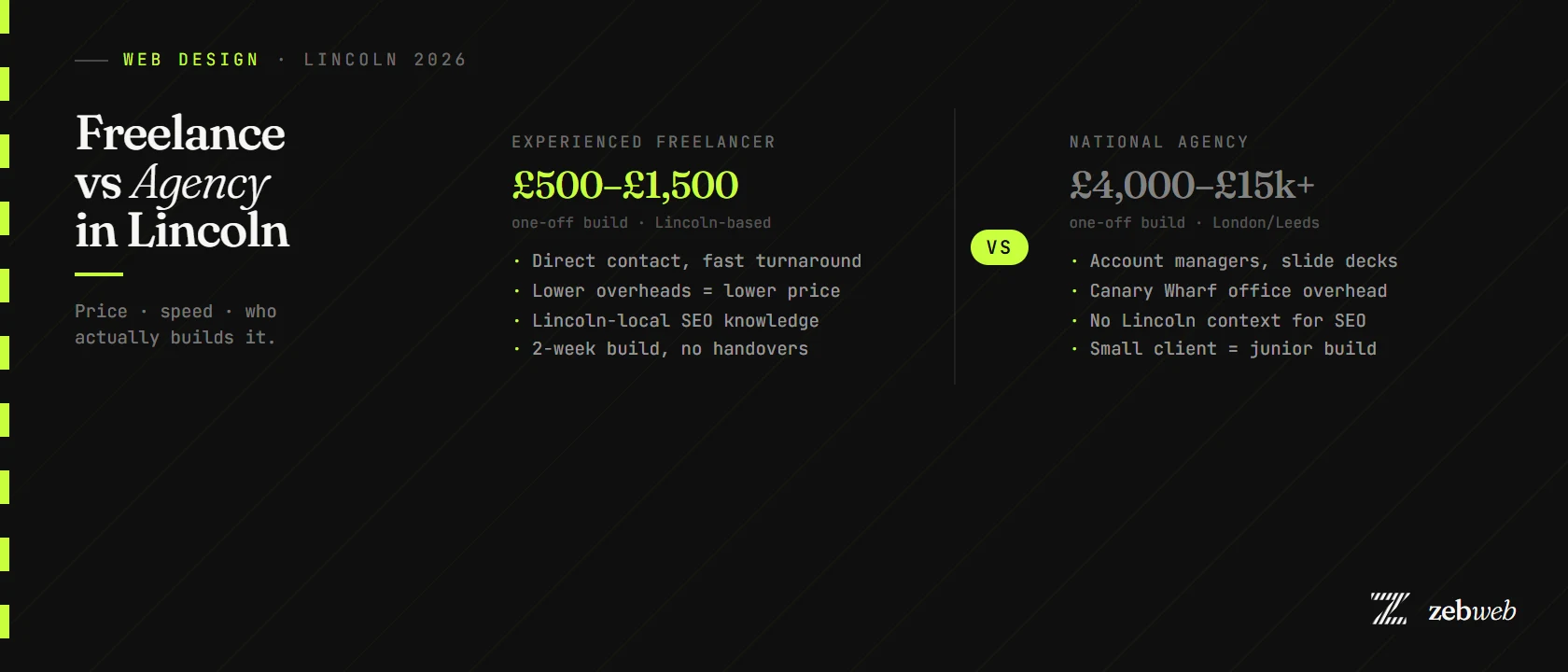
The freelance web designer
In Lincoln in 2026, "freelance web designer" usually means one of two people:
- A solo operator with five to ten years of agency experience who left to charge less and work better hours.
- A side-hustler doing it after hours, often charging £50–£100 for what would be a £1,000 job elsewhere.
Both can deliver a great site. They can also both deliver something half-finished if you pick wrong. The difference is signal — does the freelancer have a real portfolio, a working personal site, and references from Lincoln businesses you can actually phone?
What freelance gets right
- You talk to the person doing the work. No account manager, no project coordinator, no "I'll check with the team and get back to you." If you want to change a headline at 7pm, you message the person who'll change it.
- Lower overheads = lower price. No office, no sales team, no marketing budget. The freelancer charges you for their time, not for a building in Manchester.
- Faster turnaround. No internal Gantt chart. A change request gets actioned the day it's sent, not the next sprint.
- Local context, if they're local. A Lincoln freelance designer knows the Cathedral Quarter trader scene, knows which Facebook groups your customers are in, knows the Bailgate vs uphill vs downhill geography that affects how local SEO works.
Where freelance falls down
- The "what if they get hit by a bus" question. One person means one point of failure. Good freelancers mitigate this with handover docs and proper Git repos, but it's a real risk.
- Holiday and illness. Two weeks off in summer means two weeks of nothing happening on your site. Most freelancers communicate around this; a few don't.
- Variable quality. An agency has a quality bar because their reputation depends on consistency. A freelancer's quality is whatever this freelancer's quality is. Check their last three sites before signing anything.
- Strategic services. If you need user research, brand strategy, paid ads, and ten other things, a freelancer is the wrong shape for that. They're a builder, not a marketing department.
The Lincoln / Lincolnshire agency
Lincolnshire has a handful of small agencies — usually 3–10 people, often a mix of designer, developer, and account manager. They sit in a middle space: more capacity than a freelancer, lower price than a national agency, local enough to know the city.
What local agency gets right
- Continuity. If one person leaves or gets sick, another takes over. Your site doesn't grind to a halt.
- Broader skills under one roof. Most can do design, build, copy, basic SEO, and some social. Some can do ads. You don't need to assemble a team yourself.
- Local credibility. Their reputation is on the line in the same city you operate in. They can't afford to deliver badly and stay in business.
- Decent prices. Lincoln agencies charge £1,500–£5,000 for a brochure site that a London agency would charge £8,000–£20,000 for. Same code, half the overhead.
Where local agency falls down
- Still slower than freelance. An agency has internal processes — kickoff calls, design reviews, QA passes — that take days. A freelancer can compress that to hours.
- Account managers. Bigger agencies often put an account manager between you and the designer. You ask for a change; they relay it; sometimes things get lost in translation.
- Higher floor. If you only need a £500 microsite, most local agencies won't touch it — their minimum project size is usually £1,500–£3,000. Below that, you're outside their model.
- Tied to specific tools. Many Lincoln agencies are WordPress-only or Wix-only or Squarespace-only. That's fine until you outgrow the tool.
The national agency
Manchester, Leeds, London, Birmingham — bigger cities, bigger agencies. They'll happily quote a Lincoln business, especially in industries with national reach (e-commerce, professional services). The price ladder starts much higher.
What national agency gets right
- Deep specialisms. A 40-person agency has a UX researcher, a copywriter, a paid-media lead, a back-end developer. If you need that depth, you can't get it elsewhere.
- Track record at scale. They've shipped 200 sites, not 20. They know what works in your industry because they've worked in it before.
- Account-managed delivery. Calendar invites, written status updates, formal sign-off. Good for risk-averse buyers who want everything on paper.
Where national agency falls down for Lincoln businesses
- The price. Every national agency we've compared against charges 2–4× more than the equivalent Lincoln-based work. You're paying for the building, the salespeople, the discovery quarter, the slide decks. Almost none of that money touches your site.
- No local context. They don't know Lincoln. They've never been to Steep Hill, never seen the Bailgate footfall on a Saturday. Local SEO suffers because they treat Lincoln as "anywhere in the East Midlands."
- Communication lag. An eight-person team between you and the designer means a 24-hour question loop minimum. Quick decisions become slow.
- You're a small client. A £4,000 Lincoln café is a tiny project to a 40-person agency. Their A-team works on £40,000 jobs; you get juniors.
The honest price comparison
Same scope — a 10-page Lincoln local business website with service pages, contact forms, basic SEO, mobile responsive, hosting included.
- Side-hustle freelancer (Lincoln): £200–£500 build. Risk: medium-high. Quality: variable.
- Experienced freelancer (Lincoln): £500–£1,500 build, £100–£300/month. Risk: low. Quality: high if portfolio checks out.
- Local Lincoln/Lincolnshire agency: £1,500–£4,000 build, £150–£500/month. Risk: low. Quality: high.
- Mid-tier national agency (Leeds/Birmingham): £4,000–£10,000 build, £300–£800/month. Risk: low. Quality: high.
- Top-tier national agency (London): £10,000–£30,000+ build, £800–£2,500/month. Risk: low. Quality: high. Worth it only if the scope justifies that level.
When each makes sense for a Lincoln business
Pick a freelancer if: you have a single project, you can verify their work, you're under £2,000 budget, you value speed and direct contact over insurance, and you understand they take holidays.
Pick a local Lincoln/Lincolnshire agency if: you need ongoing work as well as a one-off build, you want a team backing the work, you're between £2,000–£5,000 budget, and you want the safety net of multiple staff.
Pick a national agency if: you're operating nationally yourself, your project is genuinely complex (multi-country e-commerce, deep integrations, regulated industry), you have £10,000+ budget, and you value process discipline over speed.
Don't pick anything yet if: you can't articulate what you want the website to do. No designer, freelance or agency, can save you from "I'll know it when I see it." Write your goals down first.
The hybrid (where Zebweb sits)
We're a Lincoln freelance operation with agency-grade pricing structure. One person doing the building (Louis), backed up with proper Git ownership and a documented handover process so you're never stuck. We use the same tooling stack the best agencies use — Next.js, Tailwind, Vercel hosting — without the agency overhead.
The pricing matches: £500 starting point for the small Lincoln cafe, £750 for most established SMEs, with bespoke add-ons layered on top for e-commerce or custom integrations. You can see the full price list with no haggling.
The trade-off is honest: you get freelance pricing and freelance speed, with agency-grade process (Git repos, staging URLs, written quotes, Lighthouse > 95 on every site). You don't get a 40-person team. For most Lincoln businesses, that's exactly the deal that makes sense.
What to ask before you sign anything
- Can I see your last three sites and phone the owners? Real builders have references. Side-hustlers usually don't.
- Do I own the code? If they're building on Wix Studio or Webflow on their account, you don't.
- What's the cancellation process? Page-builder sites are stuck on the page-builder. Hand-coded sites move freely.
- What happens if you can't deliver? One-person operations should have a handover doc and a real Git repo. Agencies should have substitutes in the team.
- Itemise the quote. Build, hosting, domain, edits, SEO. If they refuse to split it, walk away.
- What's your edit turnaround? A change request should take hours from a freelancer, days from an agency. Anything more is too slow.
Lincoln is a small enough city that the wrong choice costs you more than money — it costs you a year of being stuck on a site you can't fix. Spend an extra week choosing.
Build a Zebweb quote — or see our Lincoln web design service for what we actually deliver, or look at the sites we've built recently if you want real examples first.